Case study
DaVinci: coding agents are mostly plumbing
A multi-agent orchestrator that drives a task through research, planning, execution and integration tests, with human review only at the gates that matter.
· Revised · 17 min read
Most of the work in shipping a feature isn't typing the code. It's holding the whole thing in your head: what the change touches, what to build first, what breaks downstream, whether the tests actually prove anything or just pass. That coordination is the expensive part. DaVinci was my attempt to hand the coordination to a system and keep myself in the seat only where judgment earns its keep.
It takes a task and a repository and drives it the way a small team would. Research the codebase, plan the work into dependent pieces, write and test each piece, then run the whole thing end to end. You can let it go start to finish, or you can make it stop and check with you at the points that matter. I built it solo over a few months to answer a question I kept arguing about: how much of the coding-agent problem is a model problem, and how much is plumbing. The answer turned out to be mostly plumbing.
The problem
A single coding agent on a single task is a solved demo. Point it at a repo, give it a prompt, watch it churn. The trouble starts the moment the task is big enough to need a plan, or you want more than one of them running, or you want to trust the result without reading every line. Then you're not building a smarter agent, you're building the thing around the agent: the queue that holds work, the state that survives a crash, the gate where a human says yes, the logic that stops two agents from stomping each other's commits. None of that is prompt engineering. It's the boring distributed-systems stuff that decides whether the clever part ever ships. DaVinci is less a code generator than a small operations layer for a fleet of processes that don't fully trust each other. The generating is the easy tenth of it.
Anthropic's guide to building agents draws the useful line here:
Workflows are systems where LLMs and tools are orchestrated through predefined code paths. Agents, on the other hand, are systems where LLMs dynamically direct their own processes and tool usage.
DaVinci is both at once. Inside each phase, agents direct their own work against the repo. Between phases, a fixed workflow decides what runs, when, and who approves. Nearly everything in this write-up that earned its complexity lives on the workflow side of that line.
How it works
A dashboard and an orchestration API sit in front. They drive a task through four phases, each backed by its own container-style task: Research, Planning, Execution, and an Integration test. The phases don't call each other directly. Each one reports back to the API over HTTP callbacks as it makes progress, the API writes that progress to Postgres, and completing one phase is what triggers the next. Artifacts and diffs land in object storage. Everything durable lives in Postgres so a phase can die and get re-triggered without losing the thread.
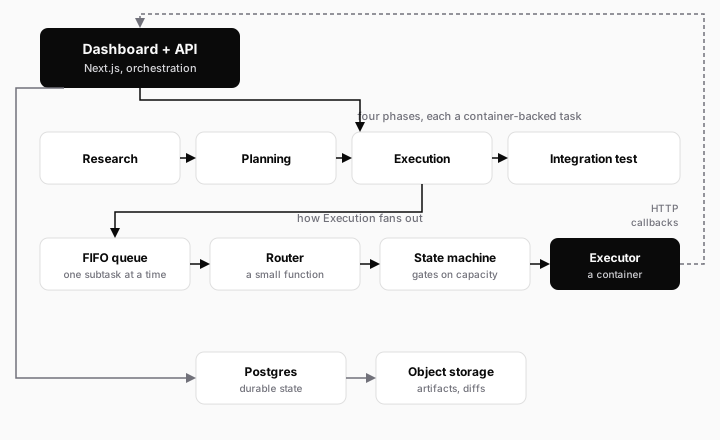
The phases talk through callbacks instead of a direct chain because the work is long and lossy. A research container might run for many minutes, and if the API held a connection open and waited, a single blip would take the whole task down. So each phase is fire-and-report: the API kicks it off, forgets about it, and reacts to callbacks. State is the only thing that connects one phase to the next, and state lives in the database, not in memory.
Four phases, two modes
Research breaks a task into three to five directions and explores them at once. A container clones the repo and runs a coding-agent CLI on each direction in parallel, and the findings stream back through the same callbacks. When the last direction reports in, that completion auto-triggers Planning. Planning aggregates the findings and produces a subtask hierarchy with explicit dependencies, so the executor later knows what can run now and what has to wait. On approval it cuts a dedicated working branch and queues the root subtasks, the ones with no dependencies.
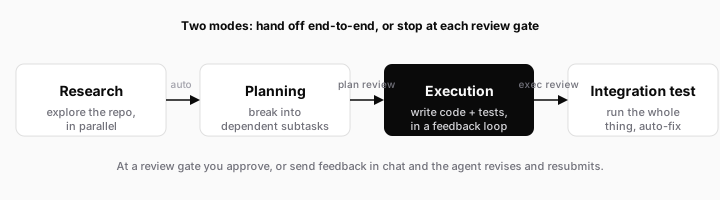
Two modes. In handoff mode it runs end to end on its own, which is fine for well-scoped work. In review mode it pauses at two gates, after planning and after execution, and waits for me to approve or push back in a chat. It revises and resubmits until I'm happy. I ended up writing a whole post on why those gates are an architecture and not a checkbox. DaVinci is where that conviction came from.
Making the executor honest
The interesting part is how a single subtask actually gets done. The lazy version hands the whole thing to one model and hopes. Instead the executor runs a small loop with three separate roles, because "write code" and "check the code" are different jobs and one model wearing both hats grades its own homework.
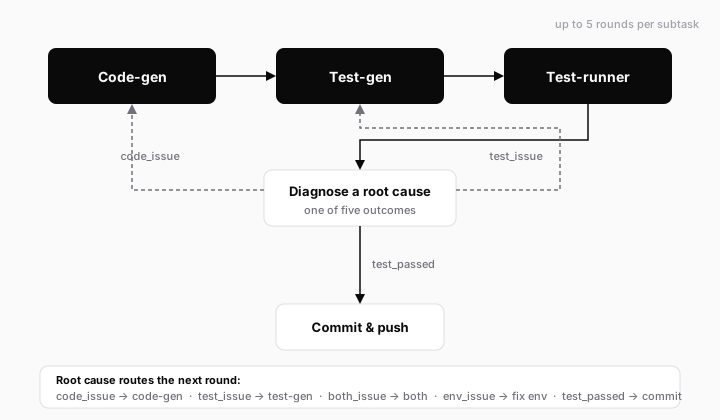
A code-gen agent writes the change. A test-gen agent writes tests against it. A test-runner runs them and, when they fail, does the part everyone skips: it diagnoses why. Every failure gets a root cause out of five: is the code wrong (code_issue), is the test wrong (test_issue), are both wrong (both_issue), is it the environment (env_issue), or did it actually pass (test_passed)? That label decides where the feedback goes next round. code_issue routes back to code-gen, test_issue to test-gen, both_issue to both, env_issue into fixing the setup rather than the diff. Blaming the code when the test was garbage only burns rounds. The loop runs up to five times, and if it can't get to green honestly, it says so and flags the subtask instead of committing a passing lie.
Five is not a magic number, but it is a considered one. Each round costs roughly a constant, call it : the container time the round occupies plus the tokens all three agents burn. That price is flat from round one to round five. The value is anything but. The failures a round can actually fix, a wrong assertion, an off-by-one, a test stubbed against the wrong module, tend to get fixed in the first attempt or two, because the diagnosis points somewhere actionable. What survives past that is structural: the plan misread the codebase, the subtask was cut at the wrong boundary, the thing it depends on doesn't exist yet. No amount of code-gen and test-gen ping-pong reaches those. So the probability that the next round is the one that rescues the subtask falls with every attempt while the cost of finding out stays , and past a few rounds you're paying full price for a lottery ticket. I won't pretend to know the exact decay curve, because I never measured one, but the shape alone justifies a cap. Five rounds bounds the worst case at and converts an open-ended tail of spend into a flagged subtask on my desk, which is the honest outcome anyway. The failures that survive five rounds were mine to fix from the start.
The same guide names the failure mode the cap exists to contain:
The autonomous nature of agents means higher costs, and the potential for compounding errors. We recommend extensive testing in sandboxed environments, along with the appropriate guardrails.
The root-cause labels are that testing done honestly. The five-round cap is the guardrail.
Running fifty without lighting money on fire
One agent is easy. The problem is fifty. Each executor is a heavy container, and if every queued subtask spun one up the instant it was ready, both the bill and the account limits would start screaming. So execution doesn't run tasks directly. It puts them on an SQS FIFO queue, a Lambda router picks them up, and a per-subtask Step Function checks for capacity before it starts anything.
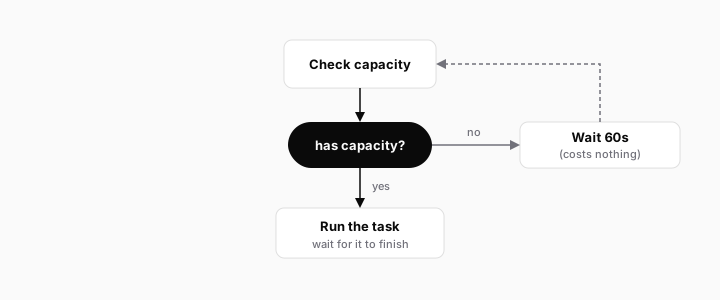
If there's room, it runs. If not, it waits sixty seconds and checks again, and the wait costs nothing, which is the entire trick. A queue that burns compute just to hold its place is a queue that taught you an expensive lesson. This one sleeps for free and wakes up when a slot opens. Concurrency stays capped, the account stays happy, and nothing gets dropped. FIFO ordering keeps a single subtask from being picked up twice on a retry.
Whether that loop is a scheduler or a holding pen comes down to one comparison. Subtasks land on the queue at some rate as their dependencies clear; call it , arrivals per minute. The cap allows executors at once, and an average run holds its slot for minutes, so a full pool retires work at per minute. If stays under , the queue drains. If it doesn't, the queue grows without bound, and no rechecking cadence can save you, because the state machine controls when work starts, never how much work exists. Little's law ties the same quantities together from the other side: the average number of subtasks in the system, queued plus running, equals the rate they arrive times the average time each one spends there, . The numbers here are illustrative, because I never measured a traffic distribution for this system, but say planning frees subtasks at two per minute and an executor run averages ten minutes. Then even with no queueing at all there are twenty subtasks in flight on average, and any cap below twenty guarantees a line that only gets longer.
The sixty-second timer sets the scheduling granularity, and it's worth being exact about what that costs. When the pool is at cap, a slot that frees up sits unnoticed until the next recheck, so the subtask that claims it starts late by whatever was left on the timer: anywhere from zero to the full sixty seconds, thirty on average. That half-interval is the whole latency price of polling instead of pushing events, and it falls straight out of the sixty-second design choice. Against the illustrative ten-minute run above it's a five percent tax on start time and nothing on run time. If subtask starts were latency-critical I'd have to wire a slot-freed event instead. They aren't, so a timer beats an event bus I'd have to operate.
What pays for all of this is an asymmetry in what waiting costs. A Step Function sleeping in a wait state bills one state transition when it wakes and nothing while it sleeps. An executor container doing the same waiting would bill container-minutes at the same rate as one doing real work. The thing that holds your place in line has to cost roughly nothing, because when the system is saturated the sleepers can outnumber the runners, and if holding a place billed like doing the work, the capacity cap would generate the exact spend it exists to prevent.
Subtasks fight over the same branch
Subtasks that share the same dependencies run in parallel, which means they race to push to the same working branch. The first one wins. The rest get rejected. So each executor, when its push bounces, fetches, rebases, and if there's a real conflict, hands both versions to a model to resolve, merging dependency additions and overlapping imports the way you would by hand. Then it tries the push again, up to five times, before it gives up and flags the subtask for me.
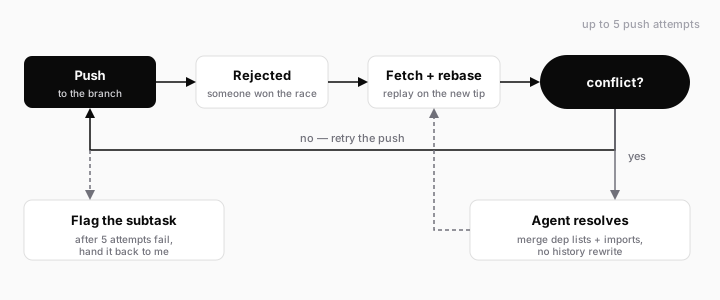
Nothing rewrites history. Every attempt, including the ones that failed and got retried, stays in the log where I can read it. The file changes for each subtask get pulled from the version-control API and stored, so the record of what landed doesn't depend on the branch staying pristine. When you're letting agents commit, the audit trail isn't a nice-to-have. It's the only reason you can trust the thing at all, a lesson that turned into another post.
When a subtask can't be saved, there are two ways out. Rerun starts a fresh attempt with an incremented number, so the failed one stays on the record. Force-bypass marks it done and unblocks its dependents, for when I've decided the dependency doesn't really matter. Both are explicit and logged.
Letting a human in without stopping the machine
In review mode the plan doesn't go straight to execution. It gets submitted to a chat gate, and nothing branches or queues until I approve. I can approve it, or I can send feedback in the chat, in which case the planner folds the feedback in, revises, and resubmits. Only on approval does DaVinci cut the working branch and queue the root subtasks.
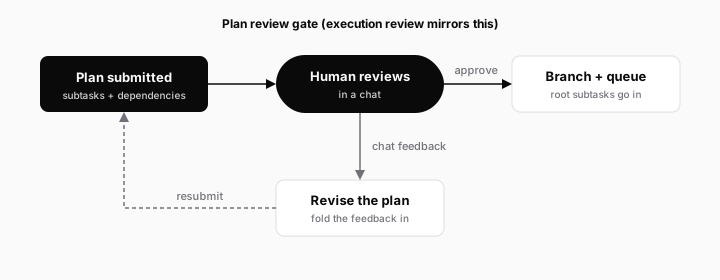
The execution review gate mirrors this one phase later: once the subtasks are committed, the same submit-review-revise loop runs before the integration test. The point of doing it this way, rather than a blocking prompt, is that the review is just another durable state. The task sits in a pending-review status in Postgres until I act. I can walk away, come back an hour later, and the chat is still there. The human is a step in the state machine, not a thread someone has to keep alive.
That durability is also what makes pause, resume, and stop work. Pausing writes the current phase into the task's status and halts the active work. Resume reads that stored phase back and re-triggers whatever got killed, which only works because no phase depended on anything held in memory. Stop is terminal. All three are just status transitions, which is the whole reason they're reliable.
The data and state model
Everything runs off a task row in Postgres with a status that walks a fixed lifecycle: pending, researching, research_complete, planning, pending_plan_review, plan_complete, executing, pending_execution_review, integration_testing, and finally completed or failed. The pending-review statuses are where the human gates live. Any phase can drop the task into failed.
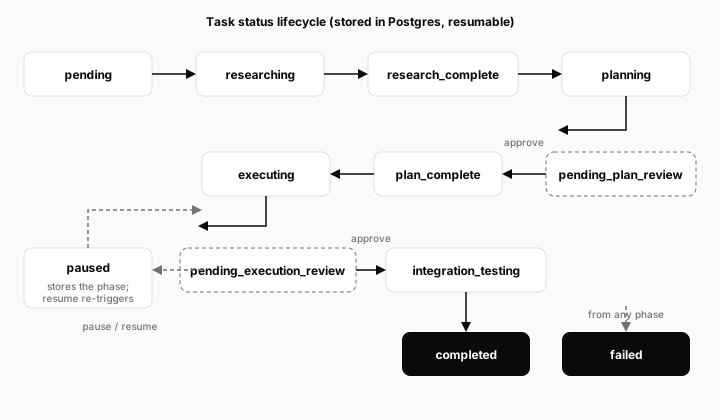
Hanging off the task are the tables that make it replayable. Research directions record what each parallel explorer found. Subtasks carry their dependencies, status, commit sha, the files they changed, and their test results. Test rounds store each pass through the executor loop with its root-cause label, so I can read back exactly why round three routed to test-gen. Integration-test runs are tracked separately because there can be more than one, and plan-review and execution-review messages are the chat transcripts of the gates. There's also a catalog of MCP tool servers a task can use and a record of which skills got invoked. It's a lot of tables for one builder, and that's the point: the schema is the audit trail, and the audit trail is what lets me trust an agent's commit without reading it.
A few things ride on top. Model selection is per phase, so research can run a cheaper model than execution. The MCP tool servers are configured per task, so a run only gets the tools it should. And task creation can be driven from a Linear issue, which is how I used it day to day: file the issue, let DaVinci pick it up.
The integration test phase
The last phase catches the lies the unit tests missed. A container sets up a real environment, node or python plus whatever services the repo needs, including a Postgres instance, and runs the regression checks: lint, type-check, the existing suite. It's allowed up to three auto-fix commits to clear those, because a broken import isn't worth flagging a human over. Once the baseline is green, an agent does feature verification, actually exercising the thing the task was supposed to build rather than trusting that green tests mean a working feature. Multiple runs get tracked, because you almost never get it in one.
Limits
There are no results here, and that's the honest headline. DaVinci never had a benchmark, a success rate or a cost per task that I could publish, and the code isn't public. Everything above describes a design that ran on my own tasks. None of it shows the orchestrator beats one good agent with a good prompt, and the review gates were only ever exercised by me.
What's next
DaVinci is shelved now. It was an experiment, and experiments earn their keep by teaching you something you carry into the next thing. Three things stuck.
Durable, resumable execution beats clever prompting. The moment a run can survive a crash and pick up where it left off, half the reliability problems stop being problems. The human belongs at specific gates, not sprinkled through every step, or you've just built a slower human. And the instant you run more than a couple of agents at once, the hard problems stop being about the model and start being about queues, capacity, conflict resolution, and who gets to push.
It stopped being a project about generating code and became a project about running a lot of processes that don't fully trust each other, safely. That second project is the one I'd build again, and its pieces keep coming back: the durable, resumable runs in KRYN's continuity layer, and the leased, retried jobs behind the voice agent's applications.
Comments